
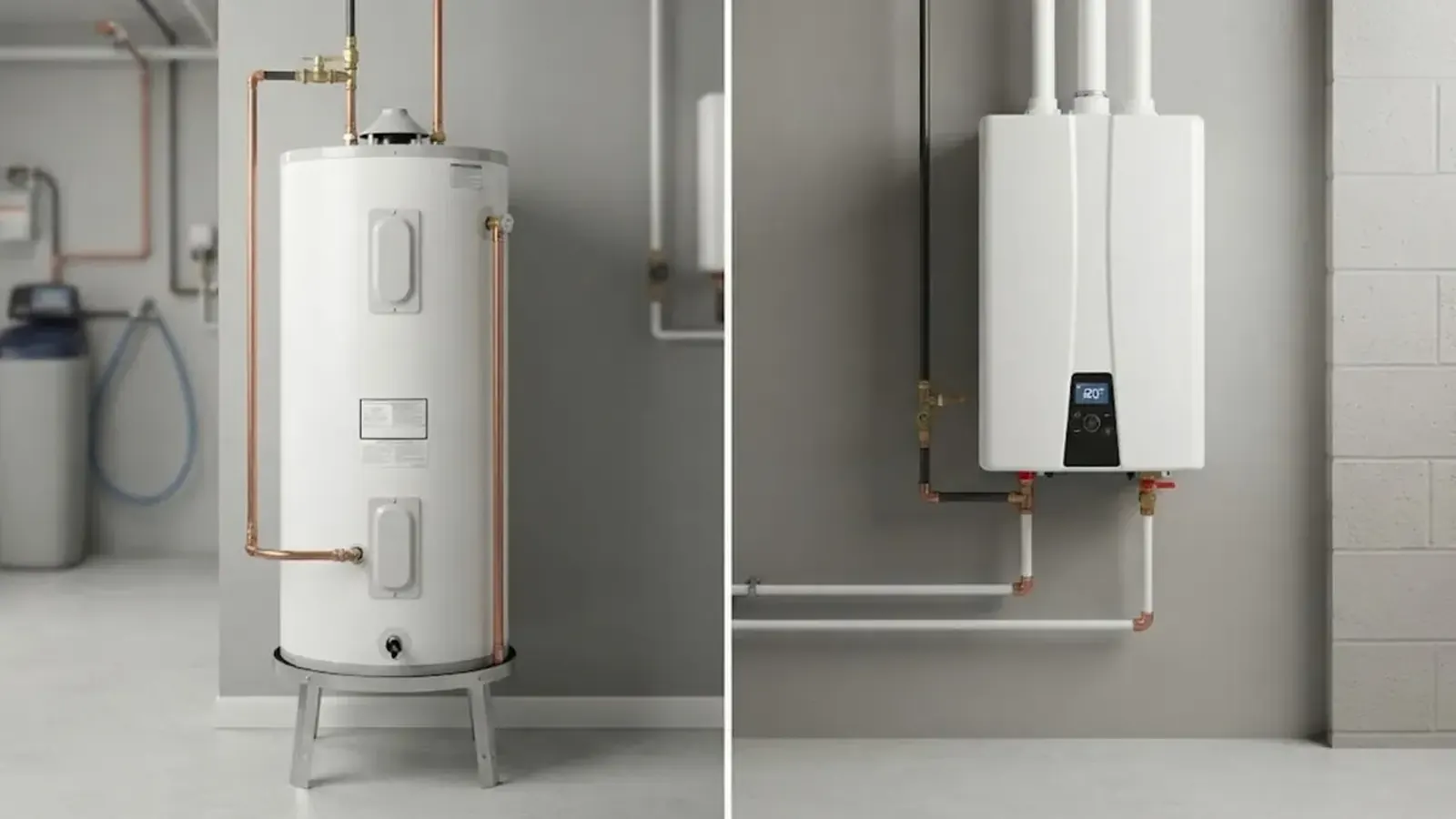
A tankless water heater has no storage tank. It heats water as it flows through a heat exchanger, and the burner or elements switch on when a tap opens. The appeal is clear: no standby heat loss, a unit the size of a suitcase and hot water for as long as the flow is within the unit's limit.
The trade-offs are also clear, and they are not the same for every house.
The advantages
These are the benefits owners tend to value most.
Continuous hot water
A tank runs out. A tankless unit keeps going as long as flow stays within its rating.
Space
A wall-hung unit frees up a closet or garage corner.
Less standby loss
A tank keeps heating water it is not using. A tankless unit heats on demand.
Long service life
Makers commonly cite a life of around 20 years with maintenance, which can exceed a tank.
Serviceable parts
Many parts can be replaced rather than the whole unit.
The drawbacks
The unit costs more than a tank and often costs more to install, because the house may need a larger gas line, new venting or a bigger electrical circuit. Output is limited. Running several showers and a dishwasher at once can exceed a unit's flow rating, and the water then cools.
Tankless heaters also need maintenance. Scale builds on the heat exchanger, and a unit that is never flushed loses efficiency. A cold water sandwich, a short burst of cold between two hot flows, annoys some owners.
Tank and tankless water heaters compared
| Question | Tank | Tankless |
|---|---|---|
| Upfront cost | Lower | Higher |
| Hot water supply | Limited by tank size | Continuous within flow rating |
| Space | Needs floor space | Wall-mounted, compact |
| Installation needs | Often a like-for-like swap | May need gas line, vent or electrical upgrades |
| Maintenance | Anode rod and flush | Flush, filter and exchanger care |
| Typical life | Roughly 8 to 12 years | Commonly cited as around 20 years with care |
Considering a tankless unit? Call and ask for a site visit.
Call (919) 944-7281Wake Forest local note: soft water and what it means for scale
Raleigh Water's 2025 drinking water quality report lists hardness at 1.49 grains per gallon at the E.M. Johnson plant and 1.44 at the D.E. Benton plant, and classifies both as soft. The pH is about 8.4, and the disinfectant is chloramine, which is chlorine combined with ammonia. The city's water laboratory takes questions at 919-996-4420.
For a tankless owner, soft water slows scale. It does not remove the need for a flush, because makers specify service intervals, and a warranty may depend on them. We follow the maker's schedule. If your unit has service valves, a flush is a short visit. See our tankless water heater page for the service details. Source type: published water quality report.
What a house needs before a tankless install
Gas units need a gas line large enough for the unit's burner, a vent to the outside and a condensate drain on high-efficiency models. Electric units need a heavy dedicated circuit, often a panel upgrade. Both need water lines sized for the flow rate. A plumber checks all of these during the site visit.
If the house is not a good fit, a standard tank installed through water heater installation may be the better choice, and there is no shame in that.
What extends the life of a tankless unit
Three habits make the most difference. Flush the heat exchanger on the maker's schedule, clean the inlet filter when you flush, and keep the area around the unit clear so it can breathe. Error codes are worth attention too. A code that returns after a reset points to a real fault, such as a venting problem, and ignoring it can shorten the unit's life.
Keep the manual and note the model and serial number on a card near the unit. A plumber can look up the exact code list and parts in minutes.
Comparing running cost without guessing
Efficiency labels help. Look for the unit's rated efficiency on the label, and compare it with a tank of the same fuel type. Then look at your own gas or electric bill. A household that uses little hot water gains less from a tankless unit than one that uses a lot, because the tank's standby loss is a larger share of its use.
Do the arithmetic with your own bills rather than a brochure. We can help you read the numbers and tell you honestly when a tank is the better value.
What to ask an installer
Good questions keep surprises off the invoice.
Is the gas line big enough?
A larger line can be a significant part of the job.
Where does the vent run?
Wall and roof runs differ in cost and appearance.
Does the quote include service valves?
They make future flushes simple.
What does the permit process look like?
A change in fuel or location is not a like-for-like swap.
What does the maker require for warranty?
Some warranties depend on a registered install and periodic service.
Deciding for your household
Tankless suits a house that wants continuous hot water, has limited space and plans to stay long enough to recover the cost. A tank suits a house that wants lower upfront cost or has constraints on gas or electrical capacity. Either answer is sound.
Call and describe your house. We cover Wake Forest and Rolesville through our Rolesville page, and the full area is on the service area page.
Questions about tankless heaters in Wake Forest
Is Wake Forest water hard on a tankless heater?
Raleigh Water's 2025 report lists the water as soft, at about 1.44 to 1.49 grains per gallon. Scale builds slowly, but a periodic flush still protects the unit and keeps the warranty valid.
Can a tankless heater run out of hot water?
Not in the way a tank does, but it has a flow limit. Running too many fixtures at once can exceed it, and the water temperature falls.