
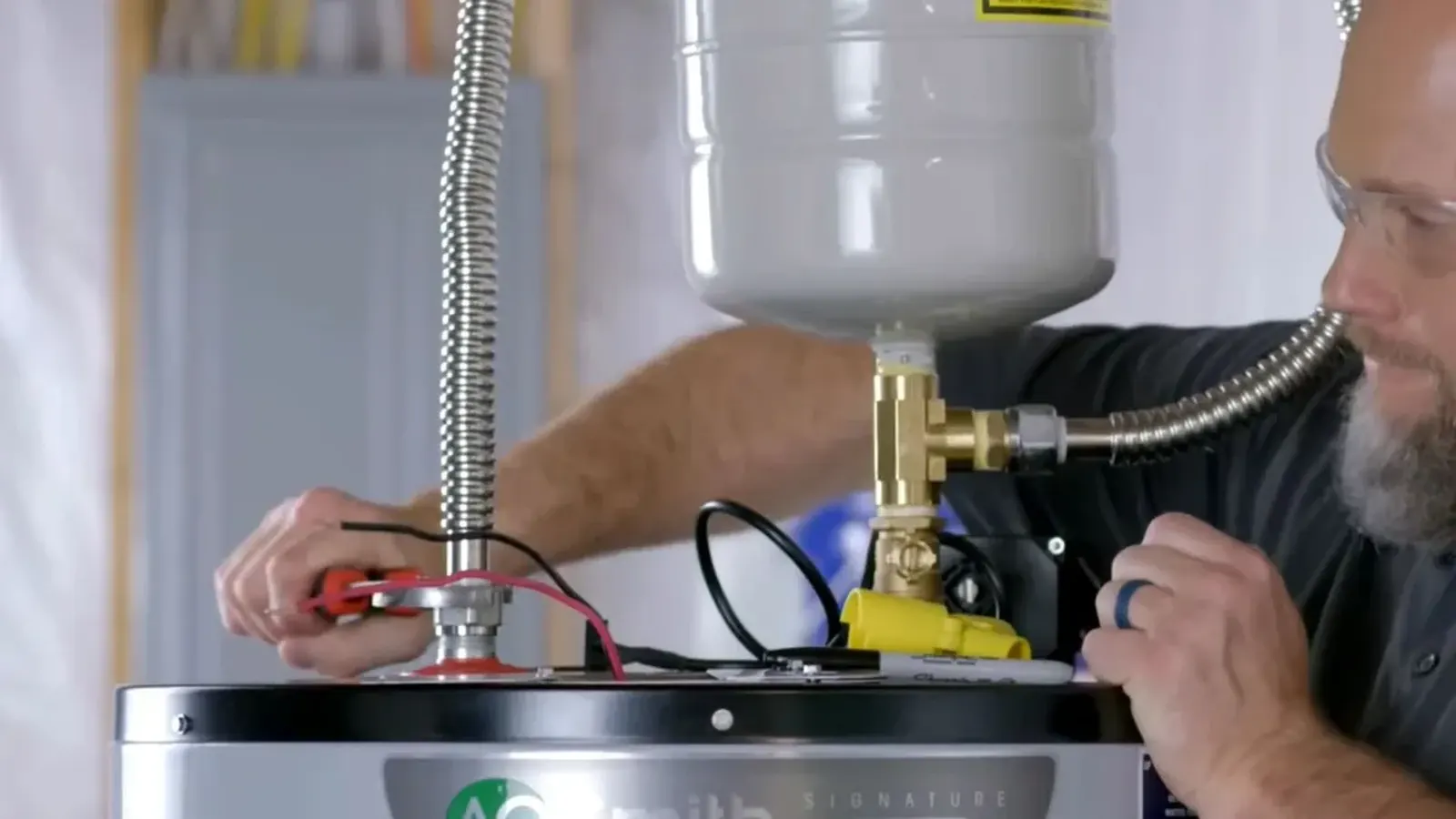
A water heater expansion tank is a small tank, usually installed on the cold line above the heater. It absorbs the extra volume when water is heated, so pressure stays within a safe range. Many homeowners learn about one only after a relief valve starts to drip.
This guide explains what the tank does, how to tell if yours has failed and what to check locally before adding one.
Why heated water needs somewhere to go
Water expands as it warms. In an open system, the expansion pushes back into the city main and no one notices. A system becomes closed when a check valve, a backflow preventer or a pressure reducing valve sits on the supply line. Then the expanded water has no way back, and pressure climbs every time the heater cycles.
That pressure rise strains fittings, faucet cartridges, the heater tank and the relief valve. The tank's air cushion absorbs it. Without one, a relief valve may weep every time the heater fires.
Signs of an expansion tank problem
| Sign | What it suggests | What to do |
|---|---|---|
| Relief valve drips after the heater runs | Pressure rising past the valve setting | Check thermal expansion, test the pressure |
| Banging pipes when the heater heats | Pressure spikes in a closed system | Add or replace the expansion tank |
| Water from the tank's air valve when pressed | The bladder has failed and the tank is waterlogged | Replace the tank |
| Tank feels full of water when tapped | A failed bladder | Replace the tank |
| Short faucet and fixture life | Chronic high pressure | Check house pressure and the PRV |
How the tank is sized and set
Tanks are sized by the volume of the water heater and the house water pressure. A common household unit is a couple of gallons in capacity. The air charge inside must be set to match the incoming water pressure before installation. A tank that arrives at the wrong pressure, or is never adjusted, does little.
Installation is a short job. The tank screws onto a tee on the cold line, and it should be supported if it is heavy, usually by a strap. A plumber checks the pressure with a gauge and sets the tank to match.
Relief valve dripping or pipes banging? Call and book a visit.
Call (919) 944-7281Wake Forest local note: permits and the Inspections Department
Wake Forest has its own Inspections Department at 301 S. Brooks St., phone 919-435-9531, and it provides inspections and permitting inside the Town. Wake County's permit guidance says a like-for-like water heater replacement in a one or two family home is exempt if the energy rate is not greater than the original, the fuel, location and venting do not change and the piping routing and sizing stay the same. That guidance covers the towns Wake County permits for.
Adding an expansion tank changes the piping, so whether it fits under an exemption is a question for the Inspections Department, not for a blog. The honest answer is to ask before you start. Our crews can tell you what the office is likely to want when you call. Source type: Town and County permit pages.
When the tank goes in with a new heater
The best time to add an expansion tank is during a heater replacement, because the pipes are open and the work adds little time. A plumber installing a new heater checks whether the system is closed and recommends the tank if it is. See water heater replacement for the full swap process.
If you are planning ahead, the same recommendation applies to a planned install through water heater installation.
Testing your house pressure
A pressure gauge on an outdoor hose bib shows your static pressure in seconds. Many households run somewhere between 40 and 80 pounds per square inch. Pressure above that range stresses fittings and appliances, and thermal expansion pushes it higher every time the heater fires. A reading near the top of the range, or above it, is a reason to check the pressure reducing valve as well as the tank.
Take the reading when no one is using water, and take a second reading after the heater has just finished a cycle. If the second number is much higher, thermal expansion is at work, and the tank is likely to help.
What happens if you skip it
A closed system without an expansion tank asks the relief valve to do the job. The valve is a safety device and was not meant to run all day. A valve that weeps can wear its seat and start to leak steadily. Fittings, faucet cartridges and the tank itself see repeated pressure swings. Some makers' installation instructions call for an expansion tank in a closed system, so skipping it can complicate a warranty claim.
Installation mistakes to avoid
The usual mistakes are an air charge that does not match the house pressure, a tank hung from a pipe with no support and a tank installed on the hot side. Each is easy to avoid when a plumber checks the pressure first and straps the tank properly.
Replacing a failed tank
Expansion tanks do not last as long as the heater. A tank with a failed bladder is a short fix, and a tank that has been sitting on the line for many years is worth checking when the heater is serviced. The tank has an air valve like a tire, and a few drops of water from it means the bladder has failed.
Getting it done
Call the dispatch line and say what you see, such as a weeping relief valve or banging pipes. We can look at it as part of a water heater repair visit. Homes in Rolesville are covered through our Rolesville page, and the full list is on the service area page.
Questions about expansion tanks in Wake Forest
Who do I ask about a permit for an expansion tank in Wake Forest?
The Town of Wake Forest Inspections Department at 919-435-9531. The Town's pages do not spell out the rule for this item, and adding a tank changes the piping, so confirm with the office.
How long does an expansion tank last?
There is no fixed number. Many last several years, but they wear out before the heater does. A tank with water coming from its air valve has failed.