
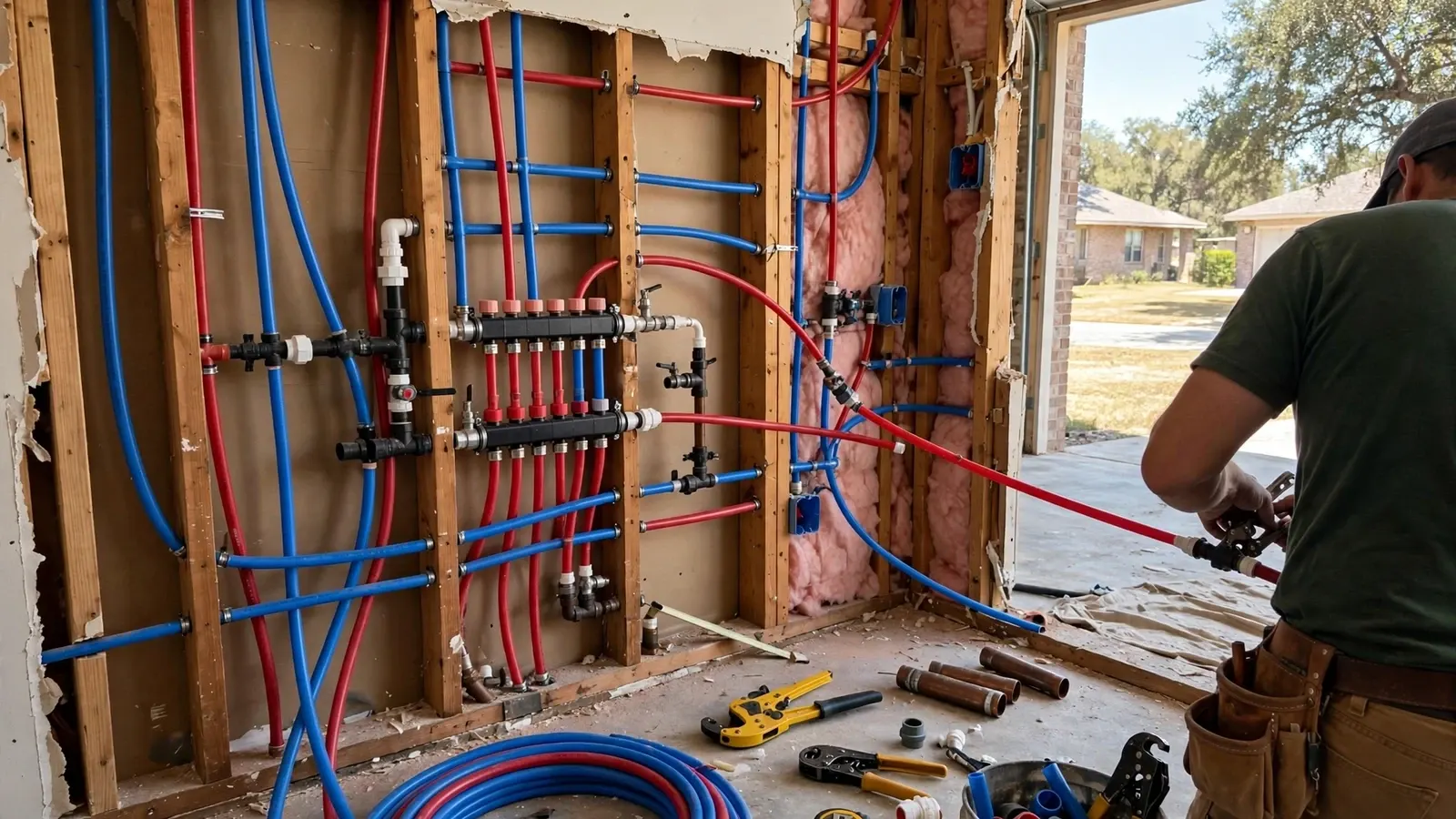
Repiping replaces a home's water supply lines, the pipes that carry water to every tap, shower and appliance. This page covers repiping in Wake Forest, NC, for houses with failing galvanized steel, polybutylene or copper lines.
Most repipes are planned, but a pipe that has just burst is not. If water is on the floor now, read burst pipe repair and call the 24/7 line. If the lines are simply wearing out, this page explains the decision.
Signs the pipes are at the end of their life
No single sign proves a house needs repiping, but several together make the case.
Repeated pinhole leaks
A second or third leak on copper in a few years usually means the pipe is thinning from the inside.
Rust-colored or metallic water
Brown water at the tap, especially in the morning, can come from corroding galvanized steel.
Low pressure at every fixture
Mineral buildup and rust narrow galvanized pipe until flow drops.
Stains on walls and ceilings
Hidden leaks leave stains before they leave puddles.
Polybutylene piping
Gray plastic pipe used in many houses from roughly the late 1970s to the mid 1990s, with a record of fitting failures.
Noisy pipes and hammering
Loose, aging runs and worn valves can produce sound.
Which pipe goes in: PEX or copper
Most repipes use PEX tubing or copper. PEX is flexible, runs through walls with fewer fittings and resists freeze splitting better than rigid pipe. Copper lasts for decades and is familiar to many buyers, but it costs more and takes more labor.
Either is a sound choice. A plumber explains which fits your house, budget and plans for selling.
Repipe materials compared
| Material | Strengths | Trade-offs |
|---|---|---|
| PEX | Flexible, fewer joints, quicker to install, resists freeze damage | Not for outdoor sun exposure, must be protected from UV and chemicals |
| Copper | Long record, rigid, familiar to buyers | Higher material cost, more labor, can pinhole in some conditions |
| CPVC | Inexpensive, resists corrosion | Brittle with age and heat, less common for new repipes |
Pipes failing again? Call and book a repipe assessment.
Call (919) 944-7281What happens during a whole-house repipe
The work is invasive but organized. Water is off for part of each day, and the crew works room by room.
Survey and plan
The plumber maps the existing lines, fixture count and access points, then plans the new routing.
Open the walls where needed
Small access holes in drywall let new lines pass. Ceilings, crawl spaces and attics are used where possible to minimize damage.
Install the new lines
New PEX or copper is run to each fixture and connected to the main.
Pressure test and inspect
The system is tested before walls are closed, and the inspector signs off where a permit applies.
Patch and restore
Access holes are patched. Painting and finishing are separate trades.
Older houses and the Wake Forest historic districts
The Glen Royall Mill Village Historic District dates from 1900 to 1949, and the Downtown Wake Forest Historic District covers buildings from roughly 1890 to 1949. Houses from that period may have had their plumbing replaced over the decades, so the pipe in the wall is whatever was installed last. A plumber can check exposed pipe in a crawl space or basement to see what you have.
Wake Forest also grew quickly from the 1990s on, according to the Town's own history page. A house built or renovated in the polybutylene era should have its piping checked. A look at pipe markings in the crawl space or by the water heater often settles it.
Permits for repiping
Wake County's permit guidance says a plumbing permit is required for installation, extension, relocation, replacement or general repair of any plumbing system, and it says this covers repiping. That guidance applies to the towns Wake County permits for, such as Rolesville. Wake Forest has its own Inspections Department at 919-435-9531, and a call confirms what applies to your address.
Code and standards behind a repipe
A repipe is done to the North Carolina State Building Code: Plumbing Code, which sets which pipe materials may be used and how they are supported, tested and inspected. Ask your plumber to name the material, the permit and the inspection that will apply before work starts.
What affects the cost of repiping
A repipe is a major project, and the price follows the house.
Insurance does not usually pay for a planned repipe, but a sudden burst and its damage may be covered. Ask your insurer before you start. Want your real number? Call (919) 944-7281.
Repiping in Wake Forest and Rolesville
We repipe houses in Wake Forest and in the 27571 ZIP code through our Rolesville page. If you are not sure the pipes are the problem, a leak detection visit tells you where the water is going, and a failing underground line is covered under water service line repair.
Questions about repiping in Wake Forest
How do I know if my house has polybutylene pipe?
Look at exposed pipe near the water heater or in the crawl space. Polybutylene is flexible gray, blue or black plastic, often stamped with the letters PB. A plumber can confirm it.
Can I repipe part of the house instead of all of it?
Yes. A partial repipe replaces the worst section, such as one bathroom group or one floor. If the rest of the pipe is the same age, it may fail soon after.
How long does a repipe take?
A typical house takes a few days. The exact time depends on the size of the house, access and inspections, and water is usually back on each evening.