
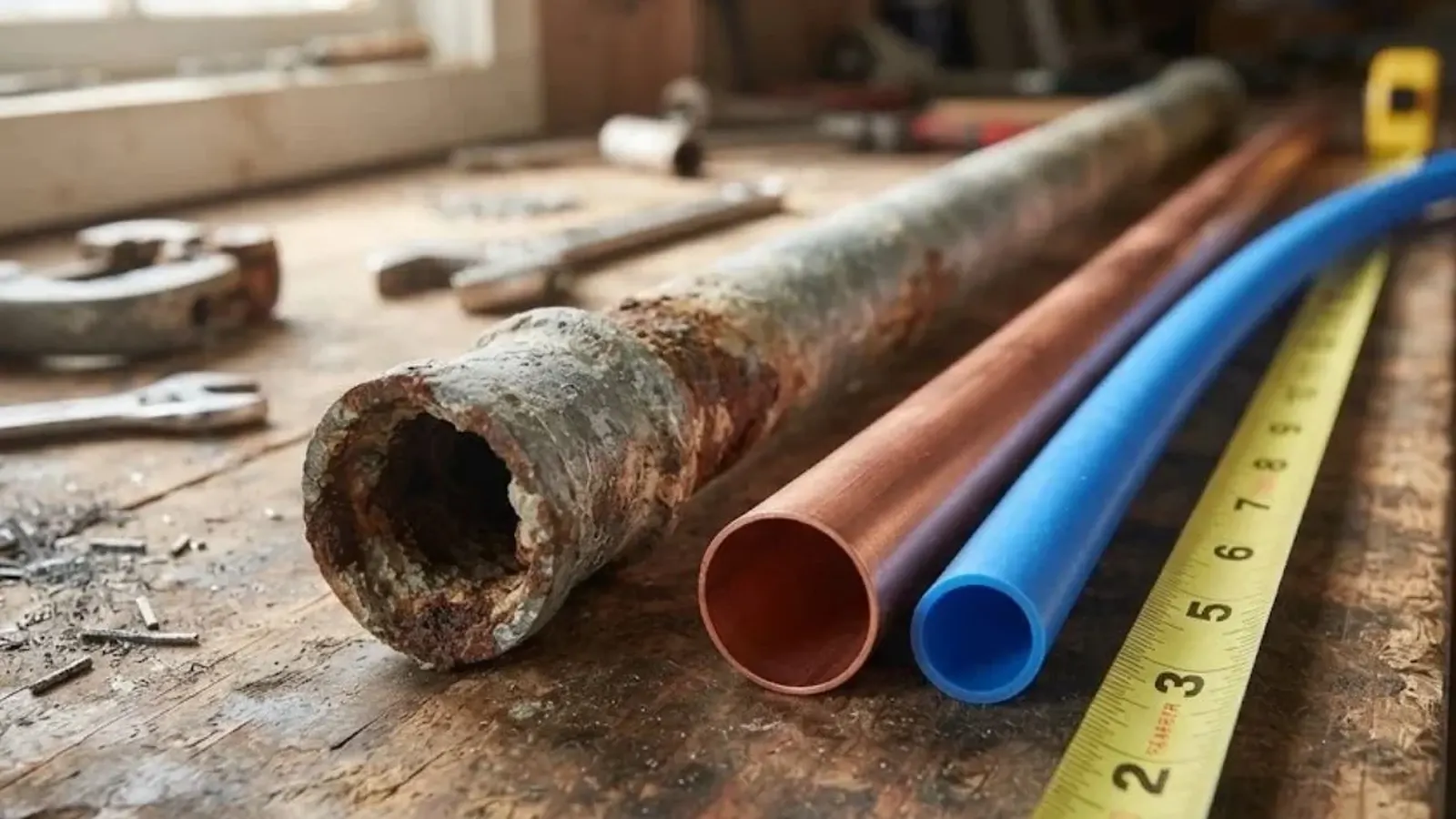
Many houses end up with both PEX and copper. A repair replaces a failed copper section with PEX, a remodel adds PEX runs to an existing copper system or a repipe is done in stages. Joining the two is common, and it works when the right fitting is used.
This guide explains the main ways to connect them, where each one fits and what to ask before work starts.
Why mix PEX and copper at all
PEX is flexible and quick to run, so it suits long runs through walls and floors. Copper is rigid and has a long record, and it remains in many existing systems. A repair often replaces a short section of failed copper with PEX because it saves time and avoids many fittings. A remodel can tie new PEX lines into the existing copper at a convenient point.
Ways to connect PEX to copper
| Connection | How it works | Best used |
|---|---|---|
| Crimp or clamp fitting with a copper adapter | A brass adapter sweats onto copper and the PEX crimps to the adapter | Permanent joints in accessible or hidden runs |
| Push-to-connect fitting | A fitting grips copper and PEX without tools | Quick repairs and tight spaces |
| Expansion fitting | PEX is expanded and slid over a fitting, then shrinks tight | New systems with a professional installer |
| Threaded transition | A threaded adapter joins PEX to a copper stub or fixture | Connections to valves and fixtures |
Rules of thumb for good joints
These practices apply however the joint is made.
Cut square and clean
A ragged cut or a burr on the copper keeps a fitting from sealing.
Use fittings listed for both pipes
The package should say it joins PEX and copper.
Support the run
Hangers and straps stop a line from sagging and loosening a joint.
Keep PEX away from heat
Do not connect PEX directly to a water heater. A metal nipple or a flex connector goes between.
Protect from sunlight
PEX degrades in direct sun, so keep it covered or indoors.
Test under pressure
Always pressure test before closing a wall.
Failed copper section? Call and a plumber can be scheduled to repair it.
Call (919) 944-7281Wake Forest local note: permits for replacing piping
Wake County's guidance says a plumbing permit is required for the installation, extension, relocation, replacement or general repair of any plumbing system. It also says minor repairs or replacement of fixtures that do not disrupt the water supply, waste or ventilation systems do not need one. Those statements apply to the towns Wake County permits for. Wake Forest has its own Inspections Department at 919-435-9531.
Swapping a failed section of copper for PEX is a repair to the supply system, and whether it needs a permit is a question for the Inspections Department. We will tell you what we know, but the office decides. Raleigh Water's 2025 report lists the water as soft, with a pH near 8.4, which is one more reason to ask the maker of any fitting what water it is rated for. Source type: County permit page and water quality report.
Mistakes that cause leaks later
The most common failure is a joint that was never fully seated. A crimp ring set off-center, a push fitting not pushed to its stop or a copper end left rough can all pass a quick look and fail weeks later. A pressure test while the wall is open catches these.
The second is stress. Pipe that is pulled tight to reach a fitting, or left to hang unsupported, puts a constant load on the joint. Leave a little slack and strap the line at the intervals the pipe maker lists.
Fittings you should not mix
Brass, copper and plated steel can corrode where they touch if the wrong pair meets. Use fittings made for the job, and keep dissimilar metals apart with the right transition piece. If a fitting's package does not say it suits both pipes, leave it on the shelf.
Also avoid reusing old fittings. A crimp ring is single use, and a push fitting that has been removed may not grip as well the second time. New parts cost little compared with a wall repair.
What a plumber adds to the job
A plumber brings the right tools, the right fittings and a habit of testing before closing up. They also know which connections the local inspector expects to see and which they will ask about. That experience is the part a parts-store kit cannot supply.
When a patch is not enough
A single failed copper section on an otherwise sound system is a repair. When copper has pinholed in several places, or the house has galvanized or polybutylene pipe, patching moves the problem along. At that point, repiping the affected lines may cost less than repeated repairs.
A failed section in the line between the meter and the house is a water service line job, and a split pipe that is flooding the house is a burst pipe repair call.
Questions to ask your plumber
Ask which fittings will be used and whether they are listed for PEX and copper. Ask who pulls the permit and what inspections apply. Ask how the work will be pressure tested and whether the test is part of the quote. A good plumber answers these without hesitation.
Getting started
Call the dispatch line, say what failed and give your address. We cover Wake Forest and Rolesville through our Rolesville page, and the full area is on the service area page. A clear price comes before work starts.
Questions about PEX and copper in Wake Forest
Does a PEX-to-copper repair need a permit in Wake Forest?
Wake County's guidance requires a permit for replacement of a plumbing system, and exempts minor fixture repairs. Wake Forest has its own Inspections Department at 919-435-9531, so ask there before the work.
Can PEX connect directly to a water heater?
No. Use a metal nipple or a flexible connector between the heater and the PEX. Most installation instructions call for this.